
An Indian wedding website has one important job: give every guest a clear, reliable answer without making them search through old WhatsApp messages or call the family. That becomes especially valuable when one celebration includes several functions, different guest lists, outstation travel, multiple venues and plans that continue to evolve. This checklist covers what to include, what to leave out, and how to arrange everything so the website remains useful from the first save-the-date to the final reception.
The complete Indian wedding website checklist
If you need the short version, a guest-ready wedding website should contain:
- The couple's names and a warm welcome
- Every function with its date, start time and expected finish time
- Venue names, full addresses and map links
- Clear information about who is invited to which event
- Per-event RSVP with a firm response deadline
- Dress codes explained in practical language
- Travel, accommodation and local transport details
- One or two useful family or wedding-help contacts
- A concise FAQ covering the questions guests will actually ask
- Optional personal sections such as your story, gallery and wedding party
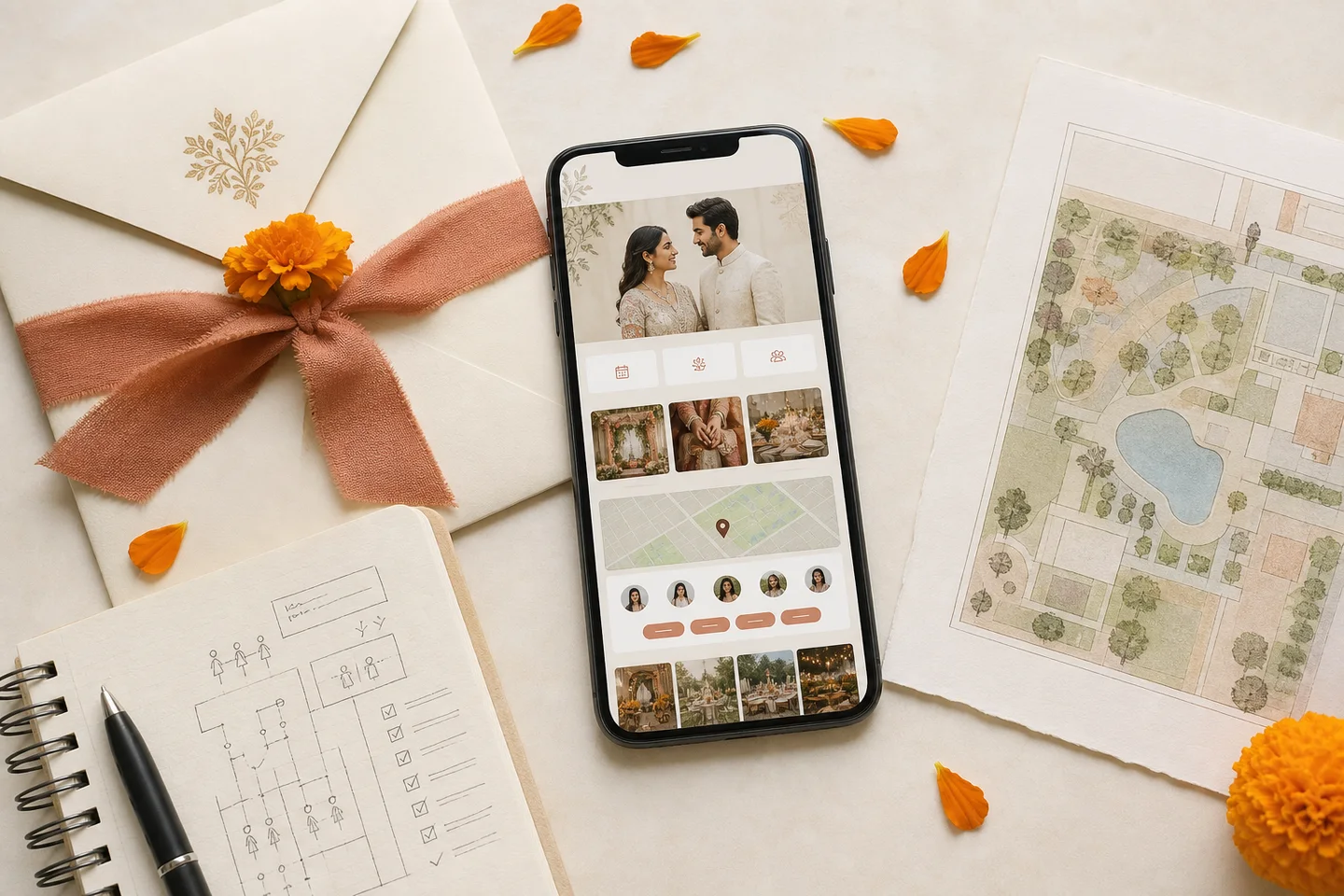
The most useful wedding website is not the one with the most sections. It is the one guests can understand in a few taps.
Begin with the guest's point of view
Couples naturally build a wedding website as a record of their celebration. Guests use it differently. They open it on a phone, often while travelling or getting ready, looking for one immediate answer: Where do I need to be, when do I need to be there, and what do I need to do?
Build the practical information first and add the decorative or personal sections afterwards. Keep the language direct, test everything on a mobile screen, and treat the website as the single source of truth. If a venue or time changes, update the website before sending guests back into a chain of corrected PDFs.
1. The couple, the hosts and a clear welcome
Start with the couple's names, the wedding dates and a short welcome. This is also the right place to acknowledge the hosting families if that matters to your invitation etiquette. A simple opening works better than a long introduction:
With the love and blessings of our families, we invite you to celebrate the wedding of Aditi and Rohan in Jaipur, 14–16 February 2027. Explore the schedule below and kindly RSVP by 10 January.
Guests should understand whose wedding it is, where it is taking place and what action is expected before they begin scrolling. If you are still finalising details, publish only what is confirmed and label the rest honestly as “details to follow.”
2. A complete multi-event schedule
An Indian wedding is rarely one date and one venue. Give every function its own entry rather than compressing the celebration into a single paragraph. For each event, include:
- Event name: Roka, Haldi, Mehndi, Sangeet, Nikah, Muhurtham, Pheras, Reception or the name your family uses.
- Date and day: include both, so guests do not have to check a calendar.
- Start time: clarify whether this means guest arrival, baraat departure, ceremony or dinner.
- Expected finish time: particularly helpful for transport, childcare and outfit planning.
- Venue: name the exact hall, lawn or ceremony space when a property contains several.
- Dress code: keep it beside the event instead of hiding every dress code on a separate page.
- Guest note: mention anything unusual, such as an outdoor ceremony, security check or footwear restriction.
Display the functions chronologically. Guests should not have to remember whether the welcome dinner appears before or after the ceremony in your design.
3. Venue details and maps that work
A venue name alone is not enough. Hotels may have similarly named properties, resorts may use a different entrance for events, and a pin dropped at the centre of a large estate can still leave a guest at the wrong gate.
For every location, add the full address, a tested map link and a short arrival note where necessary. Useful notes include:
- “Use the banquet entrance opposite Gate 2.”
- “Valet parking is available from 6:30 p.m.”
- “The ceremony lawn is a five-minute walk from the hotel lobby.”
- “Please arrive 30 minutes early for the security check.”
Test each map link on both Android and iPhone, preferably from a phone that was not used to create it. A beautiful location card is no help if its directions open at the wrong property.
4. RSVP for each event—not only the wedding
A single “Will you attend?” question cannot produce useful numbers for a multi-day celebration. A cousin may attend the sangeet and wedding but leave before the reception; a colleague may be invited only to the reception. Your website should let each guest respond to the functions included in their invitation.
Use per-event wedding RSVP and collect only information you will act on: attendance, number of permitted guests, dietary requirements and perhaps travel or accommodation needs. Show a clear deadline and explain whether one person may respond for their household. Avoid asking guests to complete a second disconnected form after they have already opened the invitation.
5. Dress codes guests can interpret
“Festive” means different things to different people. Give a level of formality, a practical description and any relevant weather advice. Colour suggestions can be inspiring, but they should rarely make guests feel that purchasing a new outfit is compulsory.
- Haldi: light Indian wear in cheerful colours; the event is outdoors and turmeric may stain.
- Sangeet: festive Indian or cocktail attire suitable for dancing.
- Wedding: traditional Indian formal; the evening may become cool after sunset.
- Reception: Indian or Western formal.
Mention terrain as well as style. “The pheras are on grass; block heels or flats will be more comfortable” is far more useful than another mood-board image.
6. Travel and accommodation for outstation guests
Outstation guests need one dependable place for logistics. Add the nearest airport or railway station, approximate transfer time, hotel name and address, check-in and check-out times, booking instructions, and whether the family has arranged rooms. If transport is provided, state the pickup point and how guests will receive their vehicle details.
Be precise about what is hosted. “Rooms have been reserved for you for 14 and 15 February” prevents awkward assumptions that “accommodation available” does not. If guests must book and pay directly, include the booking deadline and group code.
7. The right contact details
Do not make the couple the help desk during their own wedding. List one contact from each family or one dedicated wedding-help number, with responsibilities where useful: RSVP, hotel, transport or venue assistance. Ask permission before publishing anyone's number and avoid listing a large directory of relatives.
A good contact section might say: “For rooms and airport transfers, contact Meera on WhatsApp. For RSVP changes, update your response through this website or contact Arjun.”
8. Your story and photo gallery
Personal content makes the website feel like an invitation rather than an itinerary. A short version of how you met, the proposal or a note about your families is enough. Write for relatives, colleagues and friends who may know only one half of the couple.
For the gallery, choose a small, coherent set of photographs that loads quickly on mobile data. Five excellent photographs are more effective than fifty near-duplicates. Obtain permission before including private family moments or photographs of children.
9. A practical wedding FAQ
A concise FAQ can prevent dozens of repeated messages. Consider answering:
- By what date should we RSVP?
- Can I bring a plus-one or my children?
- Which events am I invited to?
- Is transport being arranged?
- Where should outstation guests stay?
- What should I wear to each function?
- Are the venues indoors, outdoors or accessible for elderly guests?
- Whom should I contact if my plans change?
- Is there a gift preference?
- May guests take and share photographs during the ceremony?
Do not add questions merely to make the page look complete. If no guest is likely to ask it, it does not need to occupy their screen.
10. Optional sections worth considering
Depending on your celebration, the following additions may be genuinely helpful:
- Wedding party introductions for a smaller or destination wedding.
- Local recommendations for guests extending their stay.
- Accessibility information covering lifts, walking distances, seating and wheelchair access.
- Weather guidance for outdoor, mountain, beach or monsoon celebrations.
- Gift guidance expressed graciously and without pressure.
- Photo-sharing instructions or a post-wedding gallery.
- Livestream details for relatives who cannot travel.
What not to publish
A wedding website is convenient because it gathers information, which also means it deserves some restraint. Do not publish guest lists, private travel records, room numbers, identity documents, payment information or family phone numbers without consent. Share sensitive logistics only with the guests who need them.
Also avoid unconfirmed timings, conflicting versions of the schedule, autoplay music that cannot be muted, enormous image files, and essential information presented only inside an image. Text should remain readable, selectable and accessible.
The best order for your wedding website
- Couple's names, dates and welcome
- RSVP action
- Event schedule
- Venues and maps
- Dress codes
- Travel and accommodation
- Story and gallery
- FAQ and contacts
This order gives urgent information priority while leaving the emotional storytelling room to breathe. You can build your free Indian wedding website with the events, story, maps, gallery and RSVP in one shareable link, then update the details as the plan becomes final.
Final check before you share the link
- Ask one person from each family to verify names, rituals and hosting language.
- Ask the venue or planner to confirm every date, time, room and entrance.
- Open every map, hotel, RSVP and contact link on a phone.
- Complete a test RSVP for different combinations of events.
- Check spelling, time zones and the distinction between noon and midnight.
- Compress images and review the website on mobile data, not only fast Wi-Fi.
- Confirm that private details are visible only to the intended guests.
- Share the final link with a relative who was not involved in planning and ask what still feels unclear.
One link, one reliable version of the wedding
The best Indian wedding website does not try to replace the warmth of a personal invitation. It supports that invitation with clarity. When the schedule, directions, RSVP and guest guidance live together—and stay current—families answer fewer repeated questions and guests arrive feeling prepared. That is the real standard: not how much the website contains, but how calmly it carries everyone through the celebration.