
Outstation guests experience an Indian wedding as a journey, not only a set of functions. Before they reach the haldi or reception, they must book travel, understand where they are staying, find the right pickup, check in at an unfamiliar hotel and keep track of a changing multi-day schedule. Managing that well does not require a larger hospitality team. It requires one reliable guest record, clear ownership and communication that arrives when it is useful.
The complete outstation guest checklist
A dependable guest-logistics plan should cover:
- One verified list of every outstation guest and household
- Arrival and departure details collected in a consistent format
- Room nights, not merely a total number of hotel rooms
- Room allocation based on households, age, accessibility and schedules
- Pickup and drop groups with vehicles, drivers and buffers
- A single guest itinerary covering functions, meals and transport
- Named logistics contacts so the couple is not the help desk
- Planned communication before travel and during the wedding
- Privacy controls for personal travel and accommodation data
- A final 72-hour review of changes, manifests and emergency plans
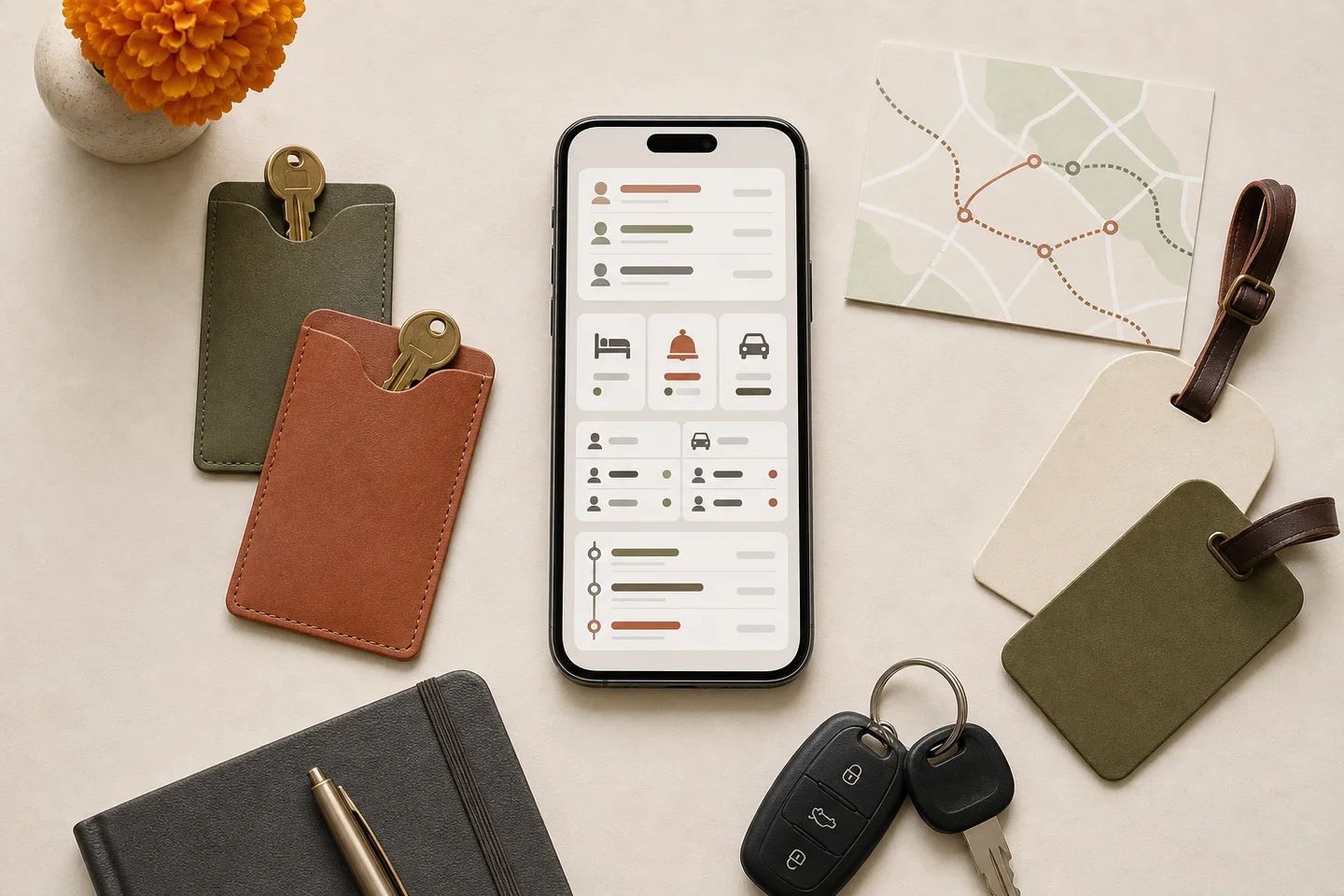
The goal is simple: every guest should know where to go, while the family can see who still needs help.
1. Build the outstation guest list early
Start as soon as the main city and dates are confirmed. Do not wait for every invitation to be ready; room blocks and transport estimates need an earlier view of demand. Add each traveller to one shared guest system and group people by household so a family of four is not treated as four unrelated requests.
For each household, record only the information the hospitality team will genuinely use:
- Guest names and one primary WhatsApp number
- City of origin
- Events included in their invitation
- Expected arrival and departure dates
- Whether accommodation is required
- Whether family-arranged transport is required
- Number of adults and children
- Mobility, medical or dietary support voluntarily shared by the guest
- The family side or host responsible for the guest
A structured wedding guest list is more useful than separate room, travel and RSVP sheets because a change to one guest remains visible everywhere that guest appears.
2. Collect travel details in one consistent format
Ask guests for travel information only after they have booked. Estimates are helpful for room planning, but they should never be confused with confirmed pickup instructions. Your travel form or guest record should capture:
- Mode of travel: flight, train, bus or private car
- Arrival point: exact airport terminal, railway station or agreed meeting point
- Arrival date and scheduled time
- Flight or train number, when required for tracking
- Number of travellers and approximate luggage
- Pickup required: yes, no or undecided
- Departure date, time and point
Set a deadline for submitting confirmed details, usually before vehicle bookings are finalised. Keep “not booked,” “details pending” and “confirmed” as separate statuses; a blank cell should never force the team to guess.
3. Calculate room nights, not just rooms
The hotel bill and inventory depend on how many rooms are occupied on each night. Forty rooms for one night and forty rooms for three nights are completely different commitments. Build a nightly requirement using confirmed arrival and departure dates.
For example, 80 guests sharing 40 rooms over two nights create 80 room nights. If twelve rooms arrive a day early, those become an additional twelve room nights. Track early check-in, late checkout, extra beds and breakfast inclusion separately because these are common sources of last-minute cost and confusion.
Before signing the hotel block, confirm:
- Room categories and occupancy rules
- Extra-bed and child policies
- Check-in and checkout times
- Early-arrival holding area or hospitality room
- Breakfast and meal inclusions
- Taxes, deposits and incidental charges
- Release date for unused rooms
- Cancellation and name-change terms
4. Allocate rooms thoughtfully
Room allocation is not a simple two-people-per-room exercise. Keep couples and immediate households together, place elderly guests closer to lifts and common areas, and avoid pairing people merely because their names fit into a spreadsheet.
Prioritise the following:
- Elderly guests and anyone requesting an accessible room
- Parents with young children
- Guests arriving late at night or leaving before dawn
- Families with caregivers or medical requirements
- Performers or close family members who share early event call times
- Guests who have explicitly agreed to share
Keep the master rooming list private. Guests need their hotel and check-in instructions, not everyone else's room assignment. Share final room numbers directly at check-in or through an authorised hospitality contact.
5. Turn arrivals into workable transport groups
Do not book one vehicle for every arrival unless the schedule truly requires it. Group guests by arrival point, practical time window, hotel and luggage requirement. Two flights landing twenty minutes apart may share a transfer; two guests landing at different terminals during peak traffic may not.
Every pickup group should have:
- A group identifier understood by the logistics team
- Guest names and primary phone numbers
- Arrival point, terminal and expected collection time
- Vehicle type and registration number
- Driver name and phone number
- Hotel or venue destination
- A luggage estimate
- A backup contact and escalation rule
Add realistic buffers for baggage collection, station exits, traffic and guests finding the pickup point. A vehicle scheduled around the published landing time instead of the likely exit time will spend the day waiting or leave too early.
6. Create one guest-facing wedding itinerary
The internal production schedule may contain hundreds of tasks. Guests need a shorter version: where to be, when to leave and what to expect. Arrange it chronologically and include hotel movements alongside the wedding functions.
A useful entry might include:
Saturday · Sangeet
Shuttle departs the hotel lobby at 6:15 p.m.
Doors open at 6:45 p.m. · Performances begin at 7:30 p.m.
Return shuttles run from 10:30 p.m. onward.
Keep venue maps, dress codes and per-event RSVP beside the relevant function. Guests should not need to compare an invitation PDF, a hotel message and a transport spreadsheet to understand one evening.
7. Communicate in stages
Sending every detail at once creates a long message that nobody can retrieve when it matters. Use a simple communication sequence:
- Six to eight weeks before: request confirmed travel details and accommodation needs.
- Two weeks before: share hotel, check-in, itinerary and general transport information.
- Three days before: send the final pickup group, driver or help-desk details and any verified changes.
- On arrival: confirm the guest has connected with the driver or reached the hotel.
- During the wedding: send only timely reminders or genuine schedule changes.
Use segmented WhatsApp communication rather than one enormous group. A guest arriving by train does not need an airport pickup update, and reception-only guests do not need the haldi shuttle reminder.
8. Give logistics clear owners
The couple should not be answering “where is my driver?” while getting ready. Assign one accountable owner to each workstream:
- Guest data: confirmations and corrections
- Hotels: rooming list, check-in and hotel coordination
- Transport: vehicles, drivers and live arrival changes
- Hospitality desk: on-site questions and welcome support
- Family escalation: decisions that require a host
Publish one guest-facing help number, then route issues internally. A visible list of five coordinators often leaves guests unsure whom to call and makes it harder to know whether a problem has already been handled.
9. Plan the arrival experience
A smooth arrival is mostly about removing uncertainty. Give the hotel the final rooming list in its required format, confirm identification requirements in advance, and arrange a clear hospitality point during the main arrival window.
Water, a light snack and a concise itinerary are usually more useful than an elaborate welcome hamper. If rooms are not ready, guests should know where they can wait, store luggage, eat and change before the next function. For a large arrival wave, a prepared check-in desk or guest check-in workflow can prevent the lobby from becoming the first queue of the wedding.
10. Account for accessibility and special circumstances
Ask guests privately whether they need step-free access, wheelchair-friendly transport, refrigeration for medicine, dietary support or help travelling with an infant. Do not infer requirements from age or appearance, and do not circulate medical information beyond the people responsible for providing that support.
Also plan for delayed flights, missed trains, lost luggage and early departures. A small backup vehicle during the busiest window is often more useful than trying to make an already full shuttle absorb every disruption.
Protect guest information
Travel and accommodation records contain personal information. Limit access to the hospitality team, collect only what the wedding requires, and remove working copies after the event when they are no longer needed. Never place identity documents, passport details, full booking references, medical notes or room numbers in open WhatsApp groups.
Share a driver's number only with the guests assigned to that driver. Likewise, give drivers only the guest information needed for that pickup—not the entire wedding guest list.
Common mistakes to avoid
- Maintaining separate guest, hotel and transport sheets with different spellings and counts
- Counting rooms without tracking arrival and departure nights
- Collecting travel details in unstructured WhatsApp conversations
- Assuming every outstation guest needs accommodation or a pickup
- Publishing a transport plan before travel details are confirmed
- Sending the same update to every guest regardless of event or route
- Making the couple or their parents the day-of logistics contact
- Sharing private rooming or travel information too widely
The final 72-hour checklist
- Reconcile the guest list, rooming list and transport manifest.
- Confirm every vehicle, driver, registration number and reporting time.
- Recheck arrivals for delays, cancellations or terminal changes.
- Send hotels the final approved rooming list.
- Confirm early check-ins, extra beds and accessible rooms.
- Send each guest only their relevant pickup and hotel instructions.
- Brief the hospitality desk on the itinerary and escalation process.
- Prepare backup transport and the after-hours contact plan.
- Freeze non-essential changes and record every necessary update in one system.
One guest record from arrival to farewell
Outstation hospitality becomes difficult when the same guest exists differently in the RSVP list, hotel sheet, driver message and family chat. The most effective fix is not another spreadsheet; it is one record that connects attendance, travel, rooms, transport and communication. Wedence is designed to manage wedding travel, hotels and guest logistics alongside per-event RSVP, reminders and check-in—so families can see the whole journey without making guests feel managed.